Communication is the foundation upon which we build trust and enable our teams to develop cohesion. - Leading in the Wildland Fire Service, page 22IGNITE the Spark for Leadership. LIKE and SHARE throughout your networks. #fireleadership #fireminis
A forum where students of fire and leadership come together to discuss, debate and exchange leadership development concepts, experience, and thoughts with an intent to promote cultural change in the workforce and strengthen the wildland fire service and the communities they serve.
Monday, August 31, 2015
IGNITE: A Foundation of Communication
Friday, August 28, 2015
What Almost Wasn't - The Butte Fire Shelter Deployment
![]() |
| (Photo credit: Jupiter Images) |
Obviously being caught in the position we were with an entire division in front of that run was not what was intended. We actually intended to pull anybody out from in front of anything. We just didn’t have time. By the time we knew we had a problem, it was too late to move anybody. – Bill Williams, Operations Section Chief
August 29, 2015, marks the 30th anniversary of the Butte fire shelter deployment on the Salmon National Forest. In what could have been one of the deadliest days in wildland fire history, an entire division of 118 people walked away; 73 off those deployed their shelters.
We challenge you to watch the Butte fire shelter deployment video, discuss the importance of fire shelters with your team, make a commitment to checking the status of your shelter, discuss updated safety zone and escape route recommendations, and reflect upon this personal story below from blog contributor Paul Talbot about his family (Flamingo Crew Boss Terry Dunford). What happens on the fireline affects our past and our future.
The Past
More information on the Butte fire shelter deployment:
The Future - What Almost Wasn't
by Paul Talbot, Wildfire Response Lead
Minnesota Department of Natural Resources
This is a picture of my cousin Mary. Mary would never have been born had her dad not survived the Butte fire shelter deployment in 1985. Her dad, Tracy Dunford, was the Crew Boss of the Flamingos you see him in the middle of the Butte Fire Shelter Deployment video and at the end saying that when he dies he’ll go to heaven because he spent his time in hell that day.
I often use this incident as a reference during S-130/190 trainings. I try to instill the fact that firefighter safety, safety zones and the shelter deployment training is of the utmost importance not only to the men and women on the line, but for who or what they will become in the future as well.
Mary was born 9 years after the Butte fire incident. At the time of the deployment, Tracy obviously had no idea what his future would hold. He could not foresee marrying Janet and creating a child who would become a beautiful, intelligent, successful and driven young woman. He could not foresee his future as a wonderful father, a great husband, or as a fire leader for the state of Utah and eventually an Incident Commander on a Type 2 Incident Management Team. Multiply that by 72 who deployed with him.
The point of this blog is to express to all of us that we are much more than firefighters on the line; we are family men and women, friends, future leaders, and good people who will create beautiful things in the future.
So keep that in mind, there’s more than just you out there. There’s you and everything you will create and become in the future.
***********************
We would like to thank Paul Talbot and the Dunford family for their willingness to share their personal story with us.
Thursday, August 27, 2015
IGNITE: More Than One Way
Where there's a will there's a way; where there's a team, there's more than one way. – Rex MurphyIGNITE the Spark for Leadership. LIKE and SHARE throughout your networks. #fireleadership #fireminis
Labels:
Food for Thought,
IGNITE,
Teamwork/Collaboration
Tuesday, August 25, 2015
Beyond the L-Courses
![]() |
| (Photo credit: Dynamic Graphics) |
Learning is a continuous process that requires a series of learning events. Assuming that becoming a leader in the wildland fire service is accomplished through completion of the leadership curriculum is short-sided and limits your potential as a wildland fire leader. This incremental approach to learning assumes that we will all become leaders of organizations and that learning is a one-time event that often occurs in a "classroom" event (whether in a room or the field). We need a series of learning events and actions that take what we learn and turn them into behaviors. A self-development plan should include a combination of training and events that complement each other and result in overall change. Additionally, creating a culture of knowledge sharing ensures that your organization as a whole is growing.
Every wildland firefighter is a leader; and as such, has a duty to be fit for command. Fit for command goes beyond the physical. Whatever level of leadership you assume, you have a responsibility to those with whom you serve. Your learning does not stop when a class is taken or publication is read. Effective students of fire and leadership routinely make time in their schedule for personal development. They don't wait for a supervisor to approve them for the next L-course. They continually review the lessons from courses, read, serve in outside organizations, watch movies, join forums, etc. They control their destiny and never stop learning or sharing their knowledge with others. They share what they learn with others.
We never know when a situation will develop that requires us to leap into action and make critical decisions that could save the lives of our fellow firefighters or even our own life. We challenge you to be the best you can be. Go beyond what is required of you and make a difference in the world around you.
Wildland Fire Leadership Challenge--Digging a Little Deeper
Develop a plan to foster your self-development.
- Watch Charles Jenning's video "Continuous Learning." Does your organization have a culture that enables learning? Is training more than 10% of your learning plan?
- Visit the self-development website and download the self-development guide and appropriate template.
- Set aside time in your schedule to learn and develop yourself regularly if not daily.
Monday, August 24, 2015
IGNITE: Unity of Effort
No matter the challenges at hand, fire leaders work together to find common ground and act in the best interests of those responding to the incident, the public, and our natural resources. – Leading in the Wildland Fire Service, page 16IGNITE the Spark for Leadership. LIKE and SHARE throughout your networks. #fireleadership #fireminis
Friday, August 21, 2015
Chaos and Exhaustion
Chaos and Exhaustion from The Smokey Generation on Vimeo.
"Fire leaders bring order to chaos, improve our people's lives, and strengthen our organizations. Leading enables us to leave a legacy for the leaders of the future so that they can take our places well prepared for the road ahead." (Leading in the Wildland Fire Service, p. 6)Fire season around the globe doesn't seem to be going away. Resources are stretched beyond capacity. Wildland firefighters from around the world are traveling to areas and fuel types different from their own. And...fire behavior is extreme in areas in and around the wildland-urban interface. Chaos and exhaustion are present, and we must step back, Take 5 @ 2, and assess the situation, and bring everyone home safely.
Today we share, a personal story on chaos and exhaustion from U.S. Forest Service District Fire Management Officer Dan Garcia.
Wildland Fire—A High-Risk Operational Environment
We are asked to make tough decisions under a compressed time frame, given limited information, in a complex and high-risk environment. This operational environment routinely brings together people, machinery, and the destructive energy of wildfire in the close, three-dimensional space of the fireground and its airspace.
Wildland fire operations have inherent risks that cannot be eliminated, even in the best of circumstances. Incident management and response is a competition between human beings and the forces of nature; leaders struggle to manage the effects caused by wildfire and other natural and man-made events. The environment can rapidly and unexpectedly change from normal to emergency conditions to complete chaos.
*******************************************
What is your story? We challenge you to become a part of this amazing project and share your leadership stories. Bethany Hannah began The Smokey Generation: A Wildland Fire Oral History and Digital Storytelling Project for her master's thesis. All members of the wildland fire service, not just hotshots, can share their stories by following her example. Click here for potential leadership questions. Visit The Smokey Generation website for complete information.
Thursday, August 20, 2015
IGNITE: Listen, Learn, Then Lead
Successful leaders don't only take action. Good leaders listen, learn, and then lead. – John MaxwellIGNITE the Spark for Leadership. LIKE and SHARE throughout your networks. #fireleadership #fireminis
Tuesday, August 18, 2015
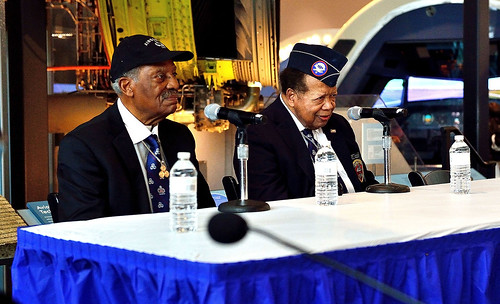
Smoke Jumping Into History
U.S. Forest Service when they think of the Smithsonian’s Air and Space Museum. But every fire season the work of the Forest Service’s planes and helicopters, carrying smokejumpers, are vitally important to controlling the spread of wildland fires.
This is why the Smithsonian recently honored the legacy of 17 of some of the most lionized smokejumpers in Forest Service history. Known as the Triple Nickles, these smokejumpers were the first all-African American crew in American firefighting.
“It was World War II. You have to remember this was a time when segregation was still a part of everyday life. But 17 black men stood up to serve their country and become the first African-American paratrooper unit,” said Deidra McGee, a Forest Service employee who has been promoting the Triple Nickles since 1994. McGee met these valiant men that year in Washington, D.C. at the Ellipse near the White House, during a ceremony commemorating Smokey Bear’s 50th birthday.
The men wanted to join the fight in Europe during World War II, but their dreams were shattered when military leaders in America and Europe feared racial tensions would disrupt war time operations. At about the same time, the Forest Service asked the military for help to minimize damage caused by balloon bombs launched by the Japanese across the Pacific Ocean with the intent to start forest fires in the western U.S..
“In the end, few of the incendiary devices reached U.S. soil, but the Triple Nickles were instrumental in helping the Forest Service fight naturally-caused fires,” said McGee. “They became history’s first military smokejumpers who answered 36 fire calls and made more than 1,200 jumps that summer of 1945.”
Sadly, the event at the Smithsonian saw none of the original Triple Nickles as only platoon member Clarence Beavers remains alive and he is physically unable to leave his bed for any extended period of time. Instead several others, with close ties to the original 17, attended to represent their comrades.
*************************
This is why the Smithsonian recently honored the legacy of 17 of some of the most lionized smokejumpers in Forest Service history. Known as the Triple Nickles, these smokejumpers were the first all-African American crew in American firefighting.
“It was World War II. You have to remember this was a time when segregation was still a part of everyday life. But 17 black men stood up to serve their country and become the first African-American paratrooper unit,” said Deidra McGee, a Forest Service employee who has been promoting the Triple Nickles since 1994. McGee met these valiant men that year in Washington, D.C. at the Ellipse near the White House, during a ceremony commemorating Smokey Bear’s 50th birthday.
The men wanted to join the fight in Europe during World War II, but their dreams were shattered when military leaders in America and Europe feared racial tensions would disrupt war time operations. At about the same time, the Forest Service asked the military for help to minimize damage caused by balloon bombs launched by the Japanese across the Pacific Ocean with the intent to start forest fires in the western U.S..
“In the end, few of the incendiary devices reached U.S. soil, but the Triple Nickles were instrumental in helping the Forest Service fight naturally-caused fires,” said McGee. “They became history’s first military smokejumpers who answered 36 fire calls and made more than 1,200 jumps that summer of 1945.”
Sadly, the event at the Smithsonian saw none of the original Triple Nickles as only platoon member Clarence Beavers remains alive and he is physically unable to leave his bed for any extended period of time. Instead several others, with close ties to the original 17, attended to represent their comrades.
*************************
Thanks to the USDA for sharing this story on their blog. Posted by Robert Hudson Westover, U.S. Forest Service, Office of Communications, on June 2, 2015.
Labels:
Change,
Courage,
Respect,
Transformational Leadership
Monday, August 17, 2015
IGNITE: Followership
He who cannot be a good follower cannot be a good leader. – AristotleIGNITE the Spark for Leadership. LIKE and SHARE throughout your networks. #fireleadership #fireminis
Friday, August 14, 2015
Building Teamwork at Rocky Mountain Engine Academy
![]() |
| A BLM engine waits for a military helicopter to land before navigating the Evasive Driving Course. |
"It's great to see so many students coming together for a common purpose before fire season," said Kyle Cowan, BLM Wyoming State Fire Management Officer. "These are the people who will be out fighting wildfires all summer and the more training we can do now, the better success we will have in the future."
At the Camp Guernsey Joint Training Center in Wyoming, 32 students recently worked with interagency partners to learn about fire engine operations. Skills taught included driving, pump operations, and working together as a unit so that when fires happen, everyone is ready. The time spent planning and developing the academy is just as valuable as interagency partnership and collaboration.
![]() |
| Students learn about air brakes in the classroom. |
![]() |
| Students get hands-on training with pumping and hydraulics. |
*****************************************
Reprinted from BLM Daily, August 10, 2015.
Subscribe to:
Posts (Atom)


