Texas A&M University may be onto an innovation that will help reduce the number of fires started by powerlines. We'll be following this technological advancement to see if how the testing phase goes.
See the full story "A&M Researchers Look to Prevent Wildfires Caused by Downed Power Lines" at KVUE.com.
Thursday, January 3, 2013


Wednesday, January 2, 2013
Leaders are Readers Challenge - January 2013

 |
| Photo credit: Defense Media Network |
Our first selection for 2013 is "It Worked for Me - In Life and Leadership" by General Colin Powell. We have featured some of General Powell's thoughts in our "Leaving a Leadership Legacy" series.
A neighborhood called "It Worked For Me" has been set up within the My Fire Community forum where students of fire can develop and post discussion questions and participate in discussion with one another. Who knows, maybe the author himself would consider becoming a member of the group. We'll pose that question on his Facebook page.
Think of ways that you can tie this book into the 2013 Leading with Courage campaign. Together we can make a difference and lead through a crisis situation.
In His Own Words
From Conflict to Teamwork: Ranchers Form Idaho's First Rangeland Fire Protection Association with BLM and State
In the spring of 2012, BLM Boise District's Fire Management and IDL provided eighteen RFPA members with basic fire training, to include principles of fighting wildland fires. This training opened the door for a positive working relationship for all parties involved. Prior to forming the RFPA, local ranchers had no way to help the BLM fight fires on public rangelands. They lacked the training, personal protective equipment, and radios for communication. And ranchers' independent, uncoordinated actions created an unsafe environment. As a fire organization, the ranchers now work with BLM fire crews to reach common objectives while enhancing safety and firefighting efficiency.
 |
| Mountain Home ranchers participating in wildland fire suppression training with Idaho Department of Lands and the Bureau of Land Management. |
In southern Idaho, there are currently 2.2 million acres that lack any formal fire protection. The RFPA helps fill part of this gap since ranchers are often first on scene and can help until the BLM arrives to form a coordinated effort. "We do make a living off this land," says Charlie Lyons, a Mountain Home rancher. Mountain Home rancher John McGrew agrees. "If we can keep that range productive, it's good for us and it's good for the game animals. That's my primary concern. It's such a waste of resources to watch it go up in smoke."
 |
| Map showing boundaries of the Mountain Home Rangeland Fire Protection Association area in southwestern Idaho. |
The agreement between the RFPA and BLM Idaho was put to use for the first time on the Stout Fire near Mountain Home in July, when ranchers helped battle the lightning-caused blaze. "This was the first fire we interacted on and incorporated the Rangeland Fire Protection Association into suppression operations, and it went very well," says Steve Acarregui, fire operations manager for the BLM Boise District. "Some of the actual firefighting resources they provided were dozers, water tenders and engines; they did a lot of line construction; and it was very beneficial." The training and coordination on fires has drastically changed the working relationships between ranchers and the BLM.
Other groups have noticed the success of this organization and have expressed interest in forming similar associations in southwestern Idaho.
Story by: Nick Yturri, BLM Boise District Fire Mitigation Specialist
Other groups have noticed the success of this organization and have expressed interest in forming similar associations in southwestern Idaho.
Story by: Nick Yturri, BLM Boise District Fire Mitigation Specialist
________________________
Reprinted from "The BLM Daily," December 20, 2012
Tuesday, January 1, 2013


Monday, December 31, 2012
NPR's Best of 2012: Using Fire to Fight Wildfire
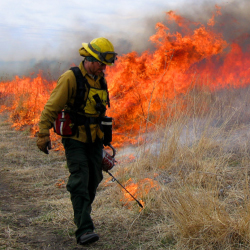 |
| (Photo credit: The Nature Conservancy) |
Friday, December 28, 2012
Looking Back at 2012

- Wildland Fire Lessons Learned Videos
- Ben Jacobs, NPS
- Jun Kinoshita, NPS
- Sue Exline & Frank Moshbacher, US Forest Service
- Brit Rosso, NPS
- Stu Hoyt, US Forest Service
- Jim Cook, US Forest Service
- Sue Husari, NPS
- Jeff Arnberger, BLM
- Chris Wilcox, US FWS
- Brett Fay, US FWS
- Bill Kaage, NPS
- FireFit
- TriData Study Anniversary
- Leaders We Would Like to Meet
- Barb Stewart, NPS
- Jim Durrwachter, US FWS
- Leaving a Leadership Legacy Series
- Wildland Fire Leadership Development Program Website Redesign
- Drexel University's LeBow College of Business Collaboration
- Announcement of the 2011 Paul Gleason Award Winners
- Tony Doty, BLM
- Travis Dotson, NPS
- Patrick Lookabaugh, NPS
- Ralph Thomas, BIA
- IGNITE the Spark for Leadership Initiative
- Putting Yourself Out There
- Sparks for PRP (Professional Reading Program) Change
Wednesday, December 26, 2012
Interconnecting to Make a Difference

I received the following comment from Debbie Wappula via our Facebook page:
"I work at a hotel. I had never dealt with a fire before and when we were home to almost 100 firefiighters over the month of October, I took it upon myself to learn everything I could as quickly as I could to help make the jobs of the overhead team a little easier...I took ICS 100, 700, and 800 online while they were here. I developed a hotel spreadsheet that the logistics guy requested when he was sent to NY for Hurricane Sandy...anything they needed, I became."
Debbie is an example to follow for our fire leaders. She willing went above and beyond her normal job duties to become a part of something bigger. Being in training, my office has addressed more requests to avoid the very classes that Debbie volunteered to take to learn more about our business. That is leadership!
Debbie in now a fan of our social media platforms and provides comments on our pages as well as supports other wildland fire partners. She embraced what many of us take for granted! Debbie became a part of our world when we entered hers. We are interconnected.
Nick Skytland, NASA, shares his experience of being a part of something bigger in an interconnected world. He shares wildland fire's connectedness with NASA during the Columbia Space Shuttle Recovery Operation. He also shares a national effort to "bring together citizens, software developers, and entrepreneurs from all over the nation to collaboratively create, build, and invent new solutions using publicly-released data, code and technology to solve challenges relevant to our neighborhoods, our cities, our states and our country."
Video Highlights:
- We are more interconnected than ever.
- Technology is shifting the way we look at our problems.
- Many citizens want to participate in government.
- Mass collaboration is possible today through technology.
The NWCG Leadership Subcommittee wants you to be a part of shaping this country and the wildland fire service for years to come. Together with the private sector and this nation's citizens we can grow and learn and be better.
Through an informal partnership with Drexel University's LeBow College of Business students have become a part of government and the development of wildland firefighters across the nation. They saw the benefits of the Leadership in Cinema program and will begin populating our library with new and innovative leadership lesson plans. This is a win-win situation for anyone wanting to grow in leadership whether a wildland firefighter or not.
I have a few questions to ask of our readers:
- How will you make the Wildland Fire Leadership Development Program more interconntected?
- How will you lead the wildland fire service to work with others to solve the problems of this great nation?
- Will you participate in the National Day of Civic Hacking in June 1-2, 2013?
For more information on the shuttle recovery effort, read "Searching For and Recovering the Space Shuttle Columbia."
Monday, December 24, 2012
Best Wishes for Happy Holidays

Whatever is good, whatever brings you joy...
May it be yours during this magical season
and throughout the coming year.
Have the best ever holiday season!
May it be yours during this magical season
and throughout the coming year.
Have the best ever holiday season!
Friday, December 21, 2012
Ready to Launch!

After nearly a year of work and consultation with the field, the NWCG Leadership Subcommittee (LSC) is prepared to launch a nationwide wildland fire leadership campaign. The 2013 campaign, Leading with Courage, runs between January 1 and November 30 with members of the wildland fire community working together to focus on a central leadership theme and begin the process of sharing leadership success stories and resources.
The success of the Wildland Fire Leadership Development Program continues to be support from the field. Therefore, all those familiar with the IGNITE the Spark for Leadership initiative are asked to be the hands and feet of the effort and spread the news of this effort like wildfire. What do you say readers? Can we do this? Can we create a movement that makes a difference in the program and the development of our fire leaders? Can you take what those who came before you created to the next level and beyond? What will your legacy be?
Campaign Intent
Task: Provide an opportunity for wildland fire service personnel to focus leadership development activities on a nationally-sponsored, centrally-themed leadership campaign and recognize local leadership participation efforts.
Purpose:
- To foster a cohesive effort to promote leadership across the wildland fire service.
- To provide a template that can be used to encourage leadership development at the local level.
- To provide a mechanism to collect leadership best practices and share throughout the wildland fire service.
End State: Creation of a wildland fire service culture that willingly shares leadership best practices in order to maintain superior service-wide leadership.

2013 Wildland Fire Leadership Campaign - Leading with Courage Reference Guide
The campaign is flexible. Local units and crews may use or adapt any or all materials contained within the Leading with Courage Reference Guide or develop a program or activity spotlighting the campaign theme and the Wildland Fire Leadership Values and Principles. Campaign coordinators are encouraged to think outside the confines of the template and develop a program that meets local and individual needs.

Using the spirit of healthy competition among wildland fire crews and personnel, the “IGNITE the Spark for Leadership Contest” is intended to be one of the mechanisms used to collect leadership best practices to be shared throughout the wildland fire service.
Wednesday, December 19, 2012
Ready to Lead

Doomsday. 2012. End of the Mayan calendar. Zombie war. Apocalypse. Geomagnetic reversal or pole shift. Loss of biological diversity. Solar flares. Collision of Planet Nibiru. Black holes. Global warming. Arrival of the next solar maximum. Galactic alignment. Timewave zero. Alien invasion. Photon Belt. Supernovas. Web Bot project.
Doomsday, as a figure of speech, means a variety of things to different people. Leadership can also have different meanings, but can ultimately be defined as the art of influencing people in order to achieve a result. So, doomsday and leadership? All disasters and chaos require leadership to step up, push through and overcome obstacles to return a state of normalcy.
As a leader, you provide duty, respect and integrity as your values and principles. Duties include proficiency, sound decisions, follow through and development. Team building, providing information and looking out for your people creates respect. Integrity applies to taking responsibility, improving and setting the example.
Leadership is about doing the right thing including setting a vision, direction, goals and plans. Every person has some leadership qualities. Such qualities consist of self-confidence, professional competence, sound judgment and appropriate decision making, ability to communicate and leadership styles. Leadership styles range from telling others what to do, convincing others by analyzing the good and bad, consulting others to participate in the decision, and joining others in the consensus of the decision. When disaster strikes, a mixed-style of leadership may be the most useful approach.
Whatever doomsday you may or may not think may happen, leadership will be needed and leaders should be ready. Whether to lead a group through that zombie war, to safety or shelter from an asteroid collision or evade an alien invasion, you, a leader, will be needed. Prior to the chaos, figure out what kind of leader you will be and what qualities you can improve. Take on doomsday and be ready to lead…Others will follow…
______________
Thanks to Jenn Smith, NWCG Leadership Subcommittee Communications, for this article.
Subscribe to:
Posts (Atom)