Showing posts with label Complacency. Show all posts

Tuesday, October 13, 2020

Change is Coming

("Swiss Cheese" by thenoodleator is licensed under CC BY-NC-ND 2.0)

We live in a period of such uncertainty. Worldwide pandemic. Wildfires raging across all western states. Double hurricanes forming. Meteoroid headed to earth. Political and social unrest. Worldwide hunger and water shortages.

Tuesday, June 23, 2020

Nothing is Routine

fire
(Photo: Kari Greer/USFS)

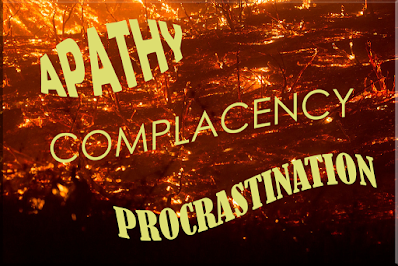
The words "apathy," "complacency," and "procrastination" have been bouncing around my head the last few of months as all things pandemic swirl around us.

Neuroscientist Dr. Donald T. Stuss* defines apathy as the "absence of responsiveness to stimuli, with the requirement that this lack of responsiveness be demonstrated by a lack of self-initiated action."

Merriam-Webster defines complacency as "self-satisfaction especially when accompanied by unawareness of actual dangers or deficiencies."

Thursday, May 14, 2020

IGNITE: Complacent Responders

fire reflecting on water
“A complacent responder can “infect” other responders."  ♦ Risk Gasaway, SA Matters ♦

[Photo: Kari Greer/USFS]

Thursday, April 18, 2019

IGNITE: Trading the Indulgences of Complacency

Fire leaders trade the indulgences of complacency, second-guessing, and fault-finding for the responsibilities of bringing order out of chaos, improving our people, and building our organizations. – Leading in the Wildland Fire Service, page 67 (large wildfire smoke plume)
[Photo credit, Wayne Grieff, Cedar fire, 2016]
Fire leaders trade the indulgences of complacency, second-guessing, and fault-finding for the responsibilities of bringing order out of chaos, improving our people, and building our organizations. – Leading in the Wildland Fire Service, page 67
Do your part and share the word.

#fireleadership #fireminis

Thursday, February 28, 2019

IGNITE: Preparing for New Growth

The question mark is an inverted plow, breaking up the hard soil of old belief and preparing for the new growth." - Saul Alensky (firefighter digging line)
The question mark is an inverted plow, breaking up the hard soil of old belief and preparing for the new growth." - Saul Alensky

Thursday, October 4, 2018

IGNITE: Say "NO" to the Status Quo

A leader who loves the status quo soon becomes a follower.   -John Maxwell  [Photo credit: Entiat IHC] (hotshot crew hiking up hill)
A leader who loves the status quo soon becomes a follower. - John Maxwell

[Photo credit: Entiat IHC]

Tuesday, March 8, 2016

Branching Out

Tree with roots on globe
(Photo credit: Hemera Technologies)
One of the best opportunities I've been a part of while on the NWCG Leadership Subcommittee the last 15 years has been the chance to benchmark other organizations (and no, not just the military). Often times these organizations have had no direct correlation to wildland firefighting but have provided great learning and growth opportunities from which to expand our program. Most recently the Wildland Fire Safety Training Annual Refresher group produced a leadership module benchmarking the Seattle Seahawks.

Leadership is much like a tree with a common root system from which we all grow. The basic leadership principles are all the same. How we apply those principles is what makes our particular branch grow and thrive...or not. By observing the health of other branches as well as own, we can identify problems early and apply care and correction to keep the rest of the tree and root structure healthy.

The Benefits of Benchmarking

Ward Group®, a leading provider of benchmarking and best practices studies for insurance companies, shares the benefits of benchmarking.

Benchmarking is a common practice and sensible exercise to establish baselines, define best practices, identify improvement opportunities and create a competitive environment within the organization. Benchmarking helps companies:
  • Gain an independent perspective about how well they perform compared to other companies 
  • Clearly identify specific areas of opportunity 
  • Validate assumptions 
  • Prioritize improvement opportunities 
  • Set performance expectations 
  • Monitor company performance and manage change
Wildland Fire Leadership Challenge - Digging a Little Deeper
  • What is your local unit/organization doing to benchmark other organizations?
  • Are other organizations benchmarking you?
  • Is there an organization you think the NWCG Leadership Subcommittee should benchmark? Contact us.
*************************************************

My First Stop - Never Stop Learning : My Two Passions Come Together
I recently had the opportunity to bring my two passions—faith and leadership development—together in the learning environment. As part of my self-development and benchmarking opportunity for the program, I attended Faith and Leadership Week (part of the Executive Scholars program) at Northwestern University's Kellogg School of Management. For four days, professors shared path-breaking thought research and current trends in leadership. Everything I learned during my week at Kellogg can and will be transferred to the wildland fire service. Students of fire leadership will recognize the topics we studied:
  • Living the Vision
  • Diversity and Inclusion
  • Persuasion and Influence
  • Decision Making
  • Team Building
  • Leading Mission-Driven Change
  • Leading Today
Faith and Leadership participants

This is a part of my personal journey for the 2016 Wildland Fire Leadership Campaign—Never Stop Learning. Be sure to check back often for the next stop on my journey...it could involve you!

*****************************************
About the Author:
Pam McDonald is a writer/editor for BLM Wildland Fire Training and Workforce Development and member of the NWCG Leadership Subcommittee. The expressions are those of the author.


Monday, February 29, 2016

IGNITE: Avoid Complacency

Our lives begin to end the day we become silent about things that matter. – Martin Luther King, Jr.

Our lives begin to end the day we become silent about things that matter. – Martin Luther King, Jr.
IGNITE the Spark for Leadership. LIKE and SHARE throughout your networks. ‪#‎fireleadership‬ ‪#‎fireminis‬
http://www.fireleadership.gov/

Friday, August 7, 2015

The "Cow Path"

Cattle trail
(Photo credit: Steve Baccon)
Cow Path

One day thru the primeval wood
A calf walked home, as good calves should,
But made a trail all bent askew,
A crooked trail, as all calves do.
Since then three hundred years have fled,
And I infer, the calf is dead;
But still behind he left his trail,
And thereon hangs my mortal tale.

The trail was taken up next day
By a lone dog that passed that way,
And then a wise bell-weather sheep
Sliding into a rut now deep,
Pursued that trail over hill and glade
Thru those old woods a path was made.

And many men wound in and out,
And dodged and turned and bent about,
and uttered words of righteous wrath
Because “twas such a crooked path”
But still they follow-do not laugh-
The first migrations of that calf.

The forest became a lane
That bent and turned and turned again;
This crooked lane became a road
where many a poor horse with his load
Toiled on beneath the burning sun,
And travelled some three miles in one.

The years passed on in swiftness fleet,
The village road became a street,
And this, before the men were aware,
A city’s crowded thoroughfare.

And soon a central street was this
In a renowned metropolis;
And men two centuries and a half
Followed the wanderings of this calf.

Each day a hundred thousand strong
Followed this zigzag calf along;
And over his crooked journey went
The traffic of a continent.

A hundred thousand men were led
By one poor calf, three centuries dead.
For just such reverence is lent
To well established precedent.

A moral lesson this might teach
Were I ordained and called to preach.

For men are prone to go it blind
Along the calf paths of the mind;
And work away from sun to sun
To do what other men have done.

– Sam Walter Foss

Leadership Discussions for the "Cow Path"

  1. How did the calf positively and negatively influence others?
  2. Can leadership occur without the intent to influence? 
  3. What are the pros and cons of following another person's lead without collecting your own situation awareness?
  4. How can complacency and group think affect an organization's operations?
  5. How does "Cow Path"relate to the 2015 Wildland Fire Leadership Campaign - Followership is Leadership? Was the cow a follower or a leader? Can you lead without a title or authority to do so? What is "conformity bias" and how can it affect you and your team?
  6. Does your team or organization operate as "creatures of habit"? Are you hearing statements like "We've always done it this way."? What are you doing to address such comments? Why is it important to address such comments?
  7. The term "new normal" is heard across the wildland fire service. Have we changed the way we conduct fire operations, training, and workforce development to compensate for this change?
  8. What are you doing personally to avoid the cow paths of life? 
  9. What are you doing as a fire leader to ensure that innovation, creativity and effective decision making are built into the fabric of your culture?
  10. Self-awareness is the starting point for leadership development. What will you do differently having read "Cow Path"?

Pathways
(Photo credit: Dynamic Graphics)
"The starting point for leadership development is self-awareness." (p. 59)

For a slightly different look at a similar topic and from more of the leadership perspective of how to lead your team beyond the status quo, read Dan Rockwell's "Cows and New Gates." 
  • 2015 Wildland Fire Leadership Campaign logo


Tuesday, September 9, 2014

Success is a Continuous Journey


"Fire leaders trade the indulgences of complacency, second-guessing, and fault-finding for the responsibilities of bringing order out of chaos, improving our people, and building our organizations." ~ Leading in the Wildland Fire Service, p. 67.
As the statement says above, wildland firefighters do not indulge in complacency. Take a moment to reflect upon the leadership lessons embedded within this short TED Talk by Richard St. John on success. Although the talk focuses mainly on financial success, the model can easily be transferred to leadership in the wildland fire environment.

Video Takeaways
  • Success is not a one-way street. Once you achieve success, don't retreat to your comfort zone and stop doing what you did to get you there.
  • Work hard and push yourself.
  • Ask questions. Be curious. Listen. Observe. Problem solve. Make connections.
  • Focus on the task and people.
  • Follow your passion and do what you love.
  • Serve others.
  • Be persistent.
(Photo credit: Richard St. John's website)