Showing posts with label Transformational Leadership. Show all posts

Friday, November 13, 2015

35 Staff Graduate BLM Leadership Academy

One year ago, 35 BLM employees began a professional and personal development journey as part of the BLM's premier leadership development program. Leadership Academy is one of several employee development training programs offered by the BLM National Training Center (NTC) in Phoenix for employees desiring to advance their leadership skills.
The curriculum is organized around the Office of Personnel Management's (OPM's) Executive Core Qualifications. These five qualifications – leading change, leading people, results driven, business acumen, and building coalitions – provide the framework for the OPM's 28 leadership competencies, which the BLM has endorsed.
The graduates of the 2015 BLM Leadership Academy.
As recent graduate Richard Fields, Assistant Field Manager at the Oklahoma Field Office, stated, "BLM's Leadership Academy does not create leaders. They are drawn to the program. What it does, and does well, is give leaders the tools and training to be successful leaders for the BLM."
The participant's journey began at the NTC where participants spent a week assessing their leadership capabilities, learning how to apply leadership theories in practice, and developing strategies to help them become more effective leaders. From there, participants spent the next 10 months completing course assignments such as working on important team projects to benefit the BLM, presenting results of team projects to the Field Committee and Executive Leadership Team, completing a minimum 60-day detail, and shadowing and interviewing admired leaders.
Leadership Academy students in session.
According to Richard White, Assistant Field Manager at the Vale District Office in Oregon, "Leadership Academy reinforced the importance of relationships and taking full advantage of every opportunity the BLM provides. The Academy expanded my network of colleagues who I can reach out to and created lifelong friendships."
Jeff Brune, Manager of BLM's Campbell Creek Science Center in Anchorage, Alaska, remarked, "My D.C. details with Public Affairs and the Division of Education, Interpretation, and Partnerships were fantastic! My projects were demanding, but we developed systems and products that I feel will bring value to the people of this great agency and the public we serve. I have a renewed sense of purpose for the BLM and for public service."
Leadership Academy students in session.
Finally, after committing hundreds of hours and mountains of energy to complete the coursework and detail requirements, their journey ended in Washington DC with Political and Organizational Realities training. The training was capped off with inspiring speeches by DOI Assistant Secretary for Lands and Minerals Janice Schneider and BLM Deputy Director Steve Ellis, followed by the crescendo moment the participants eagerly anticipated – GRADUATION! Linda Lance, BLM's Acting Deputy Director of Planning and Resources, proudly confirmed their achievements with words of congratulations and handed out graduation certificates to each of the 35 Leadership Academy graduates.
When asked if all the effort and hard work was worth it, Leadership Academy graduate Michelle Ryerson, Field Manager at the Owyhee Field Office in Idaho, exclaimed, "Yes! It surpassed my expectations. I highly encourage future leaders of the BLM to participate!"
To learn more about the BLM's Leadership Academy, contact the National Training Center Leadership Academy Coordinator at 602-906-5628. Or, ask a recent Leadership Academy Graduate!
Congratulations to the members of the 2015 Leadership Academy Graduating Class:
Tauqeer Aslam
Amanda Dodson
Edward Kender
Gregory Miller
Charles Russell
Matthew Azhocar
Al Elser
Lori Kimball
Stephanie Miller
Michelle Ryerson
Jeff Brune
Paris Everson
Jeff Kitchens
Leanne Phillips
Robyn Shoop
Elizabeth Burghard
Richard Fields
Todd Kuck
Jill Ralston
Anna Sisson
Marjorie Chiles
Melissa Garcia
Eric Lepisto
Beth Ransel
Megan Stouffer
Byron Clayton
Lenore Heppler
Shane McDonald
Aaron Rasmussen
Richard White
Dana Dennison
Rebecca Hunt
Stacie McIntosh
Kimberly Rose
Kevin Wright
 Story by Patti Klein, Acting Leadership Development Training Coordinator
****************************************
Reprinted from The BLM Daily from 10/20/15.

Friday, October 16, 2015

Fire Transforms


An Introduction: Peter Carpenter from The Smokey Generation on Vimeo.

Individuals enter the wildland fire service; firefighters emerge. For many when fire "gets in your blood," you have a hard time ever giving it up. Through the brotherhood or sisterhood, bonds are made and teams formed.

Peter Carpenter was a Redding Smokejumper from 1959 to 1961. Listen to how a career in wildland firefighting transformed his life in this video from The Smokey Generation.

How has a career in wildland firefighting transformed you?

******************************************* 
What is your story? We challenge you to become a part of this amazing  project and share your leadership stories. Bethany Hannah began The Smokey Generation: A Wildland Fire Oral History and Digital Storytelling Project for her master's thesis. All members of the wildland fire service, not just hotshots, can share their stories by following her example. Click here for potential leadership questions. Visit The Smokey Generation website for complete information.

The Smokey Generation logo

Tuesday, August 18, 2015

Smoke Jumping Into History

Thomas McFadden (left) and Joe Murchison (right)
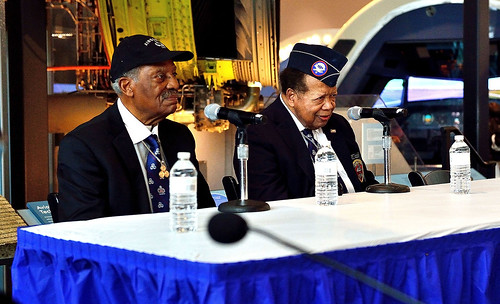
Although not original members of the first Triple Nickles Platoon, Thomas McFadden (left) and Joe Murchison (right), who is the current President of the Triple Nickles Association, attend an event at the Smithsonian Air and Space Museum honoring their comrades. (U.S. Forest Service photo)
Most people don’t conjure up images of the U.S. Forest Service when they think of the Smithsonian’s Air and Space Museum. But every fire season the work of the Forest Service’s planes and helicopters, carrying smokejumpers, are vitally important to controlling the spread of wildland fires.

This is why the Smithsonian recently honored the legacy of 17 of some of the most lionized smokejumpers in Forest Service history. Known as the Triple Nickles, these smokejumpers were the first all-African American crew in American firefighting.

“It was World War II. You have to remember this was a time when segregation was still a part of everyday life. But 17 black men stood up to serve their country and become the first African-American paratrooper unit,” said Deidra McGee, a Forest Service employee who has been promoting the Triple Nickles since 1994. McGee met these valiant men that year in Washington, D.C. at the Ellipse near the White House, during a ceremony commemorating Smokey Bear’s 50th birthday.

The men wanted to join the fight in Europe during World War II, but their dreams were shattered when military leaders in America and Europe feared racial tensions would disrupt war time operations. At about the same time, the Forest Service asked the military for help to minimize damage caused by balloon bombs launched by the Japanese across the Pacific Ocean with the intent to start forest fires in the western U.S..

“In the end, few of the incendiary devices reached U.S. soil, but the Triple Nickles were instrumental in helping the Forest Service fight naturally-caused fires,” said McGee. “They became history’s first military smokejumpers who answered 36 fire calls and made more than 1,200 jumps that summer of 1945.”

Sadly, the event at the Smithsonian saw none of the original Triple Nickles as only platoon member Clarence Beavers remains alive and he is physically unable to leave his bed for any extended period of time. Instead several others, with close ties to the original 17, attended to represent their comrades.

*************************
Thanks to the USDA for sharing this story on their blog. Posted by Robert Hudson Westover, U.S. Forest Service, Office of Communications, on June 2, 2015.

Friday, August 7, 2015

The "Cow Path"

Cattle trail
(Photo credit: Steve Baccon)
Cow Path

One day thru the primeval wood
A calf walked home, as good calves should,
But made a trail all bent askew,
A crooked trail, as all calves do.
Since then three hundred years have fled,
And I infer, the calf is dead;
But still behind he left his trail,
And thereon hangs my mortal tale.

The trail was taken up next day
By a lone dog that passed that way,
And then a wise bell-weather sheep
Sliding into a rut now deep,
Pursued that trail over hill and glade
Thru those old woods a path was made.

And many men wound in and out,
And dodged and turned and bent about,
and uttered words of righteous wrath
Because “twas such a crooked path”
But still they follow-do not laugh-
The first migrations of that calf.

The forest became a lane
That bent and turned and turned again;
This crooked lane became a road
where many a poor horse with his load
Toiled on beneath the burning sun,
And travelled some three miles in one.

The years passed on in swiftness fleet,
The village road became a street,
And this, before the men were aware,
A city’s crowded thoroughfare.

And soon a central street was this
In a renowned metropolis;
And men two centuries and a half
Followed the wanderings of this calf.

Each day a hundred thousand strong
Followed this zigzag calf along;
And over his crooked journey went
The traffic of a continent.

A hundred thousand men were led
By one poor calf, three centuries dead.
For just such reverence is lent
To well established precedent.

A moral lesson this might teach
Were I ordained and called to preach.

For men are prone to go it blind
Along the calf paths of the mind;
And work away from sun to sun
To do what other men have done.

– Sam Walter Foss

Leadership Discussions for the "Cow Path"

  1. How did the calf positively and negatively influence others?
  2. Can leadership occur without the intent to influence? 
  3. What are the pros and cons of following another person's lead without collecting your own situation awareness?
  4. How can complacency and group think affect an organization's operations?
  5. How does "Cow Path"relate to the 2015 Wildland Fire Leadership Campaign - Followership is Leadership? Was the cow a follower or a leader? Can you lead without a title or authority to do so? What is "conformity bias" and how can it affect you and your team?
  6. Does your team or organization operate as "creatures of habit"? Are you hearing statements like "We've always done it this way."? What are you doing to address such comments? Why is it important to address such comments?
  7. The term "new normal" is heard across the wildland fire service. Have we changed the way we conduct fire operations, training, and workforce development to compensate for this change?
  8. What are you doing personally to avoid the cow paths of life? 
  9. What are you doing as a fire leader to ensure that innovation, creativity and effective decision making are built into the fabric of your culture?
  10. Self-awareness is the starting point for leadership development. What will you do differently having read "Cow Path"?

Pathways
(Photo credit: Dynamic Graphics)
"The starting point for leadership development is self-awareness." (p. 59)

For a slightly different look at a similar topic and from more of the leadership perspective of how to lead your team beyond the status quo, read Dan Rockwell's "Cows and New Gates." 
  • 2015 Wildland Fire Leadership Campaign logo


Thursday, August 1, 2013

The Roman Empire in the First Century - Order from Chaos


If you know much about the Roman Empire, you are well aware of Augustus Caesar. This leader transformed the Roman Republic into an empire that spanned many years with many leaders. Augustus was loved by his people--given god-like status. A Leadership in Cinema (LinC) lesson plan is available for your use in studying his transformational leadership. The first episode of PBS's "The Roman Empire in the First Century - Order from Chaos" video series and LinC lesson plan takes an in-depth look at the leadership legacy of Augustus Caesar.

Feel free to use the Wildland Fire Leadership Development Program's Facebook page to discuss the movie and promote discussion across the program.

If you would like to create a lesson plan for the program, visit the Leadership in Cinema website.


Monday, March 25, 2013

"Transform Yourself...Transform Your People"

(Photo credit: Baptist Convention of New England)
You cannot give what you do not have. ~ John Maxwell
According to John Maxwell, reknowned leadership expert, transformational leadership "influences people to think, speak, and act in such a way that it makes a positive difference int their life and in the lives of others."

Recenty, John Maxwell offered an interactive training session on transformational leadership via a live call. If you are like me and missed the call, have no fear. John offers the recording of the call on his Join John Live! website. He supplements the call with worksheets.

John walks you through his four steps of transformation:
  1. Transformation begins with a calling - "I Want to Make a Difference"
  2. Transformation stands on a cause - "Doing Something That Makes a Difference"
  3. Transformation spreads from me to we - "With People Who Make a Difference"
  4. Transformation breathes with urgency - "At a Time When It Makes a Difference"
Transformation begins with you. Take a moment to invest in and develop self.