A forum where students of fire and leadership come together to discuss, debate and exchange leadership development concepts, experience, and thoughts with an intent to promote cultural change in the workforce and strengthen the wildland fire service and the communities they serve.
Wednesday, April 13, 2022
Learning to Learn from Accidents
Accidents—and the reviews and investigations that follow—have been part of the wildland fire service since the time before the pulaski. And over the years, the focus and the tone of accident reviews have changed.
Monday, April 11, 2022
IGNITE: What are you fighting for?
Saturday, April 9, 2022
Sharing Lessons Throughout the Organization
Leaders evaluate performance at all levels to understand the causal factors of successes and failures. All those involved learn incrementally, applying today’s lessons to the next assignment. This focus on continuous process and product improvement brings with it a responsibility to share lessons learned throughout the organization.
In a learning organization, leaders treat honest mistakes as opportunities to do better next time. Understanding that failure is a part of learning, they establish command climates in which young leaders are motivated by a desire to succeed rather than a fear of failure.
[Click here to download Learning in the Wildland Fire Service.]
Friday, April 8, 2022
Challenge #14 - 2022 WFLDP Campaign
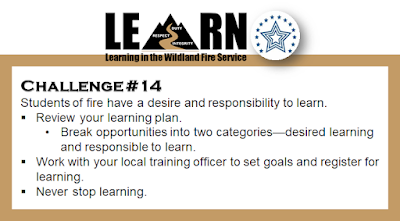
Challenge #14 - Students of fire have a desire and responsibility to learn.
- Review
your learning plan.
- Break
opportunities into two categories—desired learning and responsible to
learn.
- Work
with your local training officer to set goals and register for learning.
- Never
stop learning.
Thursday, April 7, 2022
IGNITE: Trust and Communication

[Photo: UAF Wildland Fire Crew]
Wednesday, April 6, 2022
Desire and Responsibility to Learn
To be effective in this dynamic, high-risk occupation we must accept the perpetual cycle of acquiring, shaping, and honing knowledge and skills. The learning journey is never finished.
“If you choose to lead others you will have a legacy. I suppose I would want my legacy to be that firefighters begin to realize the importance of being a student of fire, and that I was able to help make that happen.” - Paul Gleason
Tuesday, April 5, 2022
By Endurance We Conquer
Ernest Shackleton and his Antarctic expedition has been a study within the WFLDP since its formation. After 107 years, Shackleton's lost ship "Endurance" was found at the bottom of the Weddell Sea, renewing excitement for the leadership story. I encourage you to learn about (or better yet, share your knowledge of) the expedition.
We have started a list of resources you can use to conduct a case study of the expedition and one of the most powerful stories of resilience on record. We challenge you to share your resources in the comments.
Monday, April 4, 2022
IGNITE: Cast Your Net Widely
[Photo: Kyle Miller/Wyoming IHC]
Saturday, April 2, 2022
For Example: "What-ifing"
We train to complete a 500-foot progressive hose lay on flat ground within 10 minutes.
We educate firefighters about pump theory and properly laying hose on a fire.
Then we experience that event for real. Afterwards, we inquire about how we could have done it better or faster. We talk about how to be more efficient and more effective in the future. Next, we create opportunities for more training or education, as needed.
We design learning experiences by “What-ifing” the conditions that we expect may occur in the future.
What if the hose lay was up or down a steep slope? What if it has to be done in heavy thick brush? How do you react to a spot fire or slop-over behind the lead nozzle? What if a hose ruptures?
[Click here to download Learning in the Wildland Fire Service."]
Friday, April 1, 2022
Challenge #13 - 2022 WFLDP Campaign
Challenge #13: When planning and conducting teaching and learning, leaders target behaviors for change. Be better!
- Assess your leadership environment.
- Identify weaknesses in the organization.
- Ensure team and individual behaviors are ethical and align with organizational values.
- Seek an outside source to ensure that perceptions match reality.
- Develop a plan for behavioral change.
- Implement the plan.


